There’s nothing quite like jumping in the shower and getting a blast of cold water when you were expecting warmth. Or turning on the hot tap and waiting… and waiting… and nothing happens. When your hot water cylinder starts playing up, it’s tempting to call a plumber, get it patched up, and hope for the best. But sometimes, a repair is just delaying the inevitable and knowing the difference could save you a lot of money and stress.
At Grace Plumbing, we’ve been looking after Auckland homes for over 20 years. We’ve seen every kind of hot water cylinder problem you can imagine. And while we’re always happy to carry out a repair when that’s the right call, we’ll also be straight with you when replacing your cylinder makes more sense than throwing money at an ageing unit. Here’s how to tell which situation you’re in.
How Long Do Hot Water Cylinders Last?
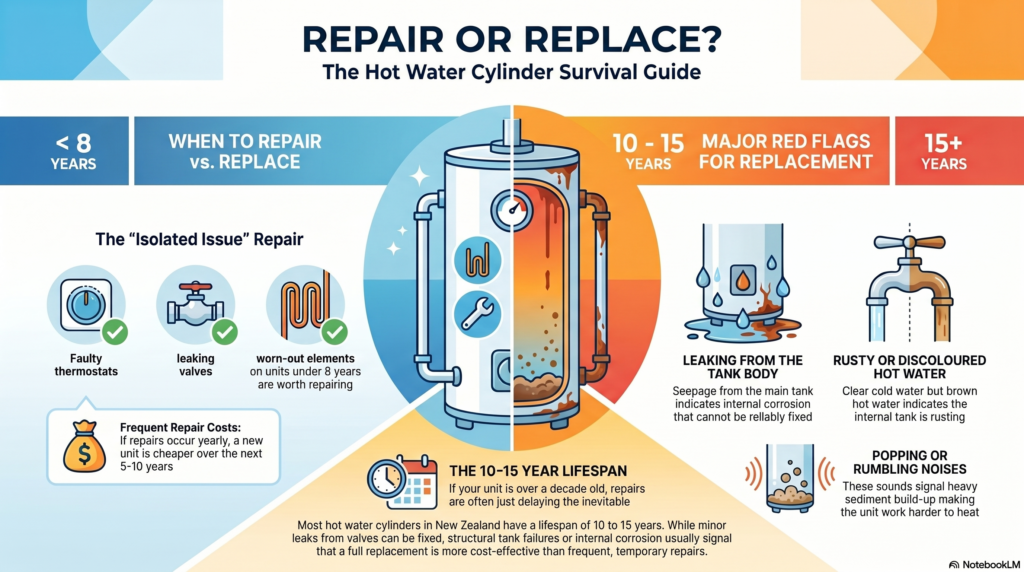
Before we get into the warning signs, it helps to know what a reasonable lifespan looks like. Most hot water cylinders in New Zealand last somewhere between 10 and 15 years. Some will push past that mark with good maintenance, but many start showing signs of wear well before the 15-year mark especially if they’ve never had a service or the anode rod hasn’t been replaced.
If your cylinder is already in that 10-to-15-year window and it starts giving you trouble, that’s an important piece of context. A repair on a 12-year-old cylinder might buy you another year or two at best, while a new unit could give you 15 more years of reliable hot water.
The Signs It’s Time to Replace, Not Repair
Your Cylinder Is Leaking From the Tank Itself
Not all leaks are the same. A small drip from a valve or a fitting is usually a straightforward repair valves wear out over time and can be replaced without touching the tank. But if water is seeping from the tank body itself, that’s a very different story.
A leaking tank almost always means corrosion has eaten through the internal lining. Once that happens, there’s no reliable fix. Even if you could patch it temporarily, the corrosion will spread, and the leak will often be worse. If your plumber tells you the tank itself is leaking, a replacement is almost certainly the right move.
You’re Running Out of Hot Water More Quickly Than You Used To
Hot water cylinders can lose efficiency over time as sediment, mainly calcium and minerals from the water supply, builds up at the bottom of the tank. This sediment layer sits between the heating element and the water, making it harder to heat the water properly and reducing the effective capacity of your cylinder.
If your household hasn’t changed but you’re suddenly running out of hot water halfway through the morning routine, a build-up of sediment could be the culprit. In some cases, a service can help, but if the build-up is severe or the cylinder is already getting on in years, you’ll often get better value from a replacement than a repair.
Strange Noises Coming From the Cylinder
Does your hot water cylinder pop, bang, or rumble when it heats up? That noise is almost always sediment being disturbed as the water heats around it. While it might not sound like much, those noises are a sign that your cylinder is working harder than it should and that the heating element or cylinder body may not be far behind.
A bit of noise on its own isn’t necessarily a reason to replace immediately, but paired with other signs on this list, it’s worth taking seriously.
Rusty or Discoloured Hot Water
If the hot water coming out of your taps looks rusty, brownish, or just off, that’s a major warning sign. It usually means corrosion is happening inside the tank. Rust in your hot water supply is not something you want to ignore — it can affect the quality of your water, your appliances, and your pipes.
Cold water that looks clear but hot water that looks discoloured is a strong indicator that the problem lies with the cylinder itself. At that point, a replacement is almost always the recommended course of action.
Frequent Repairs Adding Up
One repair is normal. Two repairs in a couple of years are getting costly. If you find yourself calling a plumber every year or two to fix something on the same cylinder, it’s worth doing the sums. Hot water cylinder repairs aren’t cheap, and if you’re spending several hundred dollars every year or two on a cylinder that’s already past its best, a new unit will likely work out cheaper over the next five to ten years — and it’ll come with a warranty.
Think of it like an old car. At some point, the money you’re spending on fixes outweighs what the car is worth and what a newer, more reliable model would cost you.
Your Energy Bills Have Gone Up Without Explanation
A hot water cylinder that’s struggling to heat water efficiently will use more electricity to do the same job. If your power bills have crept up and you can’t point to an obvious reason, an inefficient cylinder could be part of the problem. Modern hot water cylinders, especially heat pump hot water systems, are significantly more energy-efficient than older units, so upgrading could actually reduce your running costs over time.
The Pressure Relief Valve Keeps Activating
The temperature and pressure relief valve (TPR valve) is a safety feature built into every hot water cylinder. It’s designed to release pressure if things get too hot or the pressure builds too high inside the tank. Occasional small amounts of water dripping from the valve is normal, but if it’s discharging large amounts regularly, or if it keeps tripping, something isn’t right.
Sometimes this can be fixed by replacing the valve, but if it keeps happening, it can be a sign that the cylinder itself is failing and the internal pressure is consistently outside the normal range. This one is worth getting checked; a faulty or overwhelmed TPR valve quickly is a safety issue.
When a Repair Is the Right Call
To be fair, not every problem with your hot water cylinder means you need a new one. If your cylinder is less than eight years old, has been well maintained, and the issue is isolated a faulty thermostat, a worn-out element, or a leaking valve, a repair is often the smart choice. These are relatively affordable fixes that can give your cylinder several more years of reliable service.
The key is getting an honest assessment from a plumber who’ll tell you what’s actually going on rather than just recommending the most expensive option. At Grace Plumbing, we’ll always give you a straight answer: if a repair makes sense, we’ll say so. If it doesn’t, we’ll explain why and walk you through your replacement options.
Thinking About Upgrading? Here’s What to Consider
If your cylinder does need replacing, it’s actually a great opportunity to upgrade to a more efficient system. Many Auckland homes are moving to heat pump hot water systems, which use significantly less electricity than a standard electric cylinder. While the upfront cost is higher, the savings on your power bill over time can make it well worth it.
If your home has a gas connection, a gas hot water system is another option worth exploring. Our gas fitting team can help you work out whether a gas hot water unit makes sense for your home and your budget.
Not sure what the right size or type of cylinder is for your household? That’s exactly the kind of question we’re happy to answer before you commit to anything.
Get an Honest Assessment From Grace Plumbing
If your hot water cylinder is giving you trouble and you’re not sure whether it needs a repair or a replacement, give the team at Grace Plumbing a call. We’ve been helping Auckland homeowners get reliable hot water for over 20 years, and we’re not in the business of recommending work you don’t need.
We service all types of hot water cylinders across Auckland — from Mount Wellington and Penrose to Remuera, Howick, and everywhere in between. Same-day service is often available, and we’ll give you upfront pricing before we start any work.
Call us on 09 5255 733 or get a free quote online today.